Choosing the right stainless steel Dutch ovens is not simply a matter of comparing prices. It involves heat control, durability, capacity, lid design, and everyday handling. A heavy pot may sear beautifully, yet feel tiring when filled with soup. A lighter model may be easier to lift, but distribute heat less evenly.
Market data shows why this cookware category deserves closer attention. Grand View Research valued the global cookware market at approximately USD 19.8 billion in 2023 and projected continued growth through 2030. Fortune Business Insights reported a similarly expanding market, although its figures differ because the research scope and product categories vary. These reports suggest stronger consumer interest in durable, reusable kitchen equipment. They do not prove that every premium pot performs well.
Material standards also matter. The U.S. Food and Drug Administration’s Food Code emphasizes food-contact surfaces that are smooth, durable, and corrosion-resistant. Stainless steel generally supports these requirements when it is properly manufactured and maintained. However, steel grade, wall thickness, enamel quality, and handle construction can change the cooking experience significantly.
Real kitchens expose the differences. Tomato sauce can reveal staining. A long braise can test lid fit and heat retention. An awkward handle becomes noticeable after lifting six liters of stew. Some claims are easy to repeat, but harder to verify. This guide compares seven leading stainless steel Dutch ovens using practical criteria, manufacturer specifications, user-focused observations, and available industry evidence. The ranking is not absolute. Your stovetop, cooking habits, and lifting comfort may change the result.
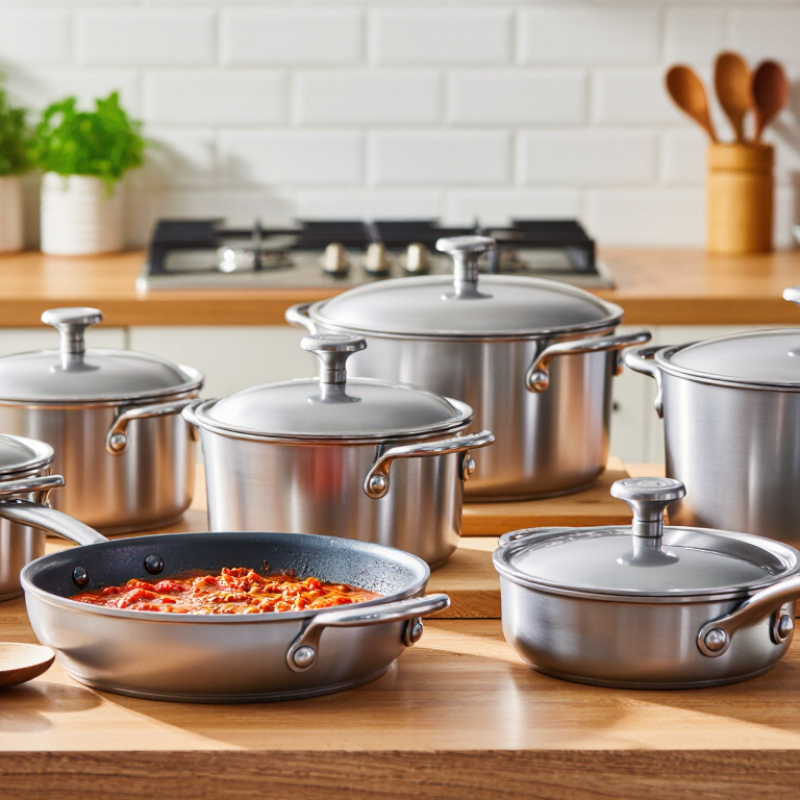
What Makes Stainless Steel Dutch Ovens Different
Stainless steel Dutch ovens differ mainly through heat control, durability, and cooking chemistry. Stainless steel is nonreactive, so acidic tomato sauce, wine, and citrus-based dishes rarely affect its flavor. That matters during long braises. However, stainless steel alone distributes heat slowly. The ASM Handbook reports thermal conductivity near 16 W/m·K for common austenitic stainless steel, compared with roughly 200 W/m·K for aluminum. A layered base can reduce scorching, but it cannot erase every hot spot.
Construction deserves close inspection. A thick, bonded aluminum or copper core usually spreads heat more evenly than a thin steel base. The U.S. Department of Energy’s Energy Saver guidance recommends matching cookware size to the burner, because poor contact wastes energy and heats unevenly. This advice feels basic. It is often ignored. Stainless steel also resists staining and does not need seasoning, unlike traditional bare cast iron. Yet it may feel less forgiving when onions stick. That is a learning curve, not necessarily a defect. ASTM A240/A240M specifications help verify stainless sheet quality, but they do not guarantee excellent cooking performance.
Tips: Choose a flat, heavy base for induction cooking. Check the lid and handle temperature rating before oven use. Preheat gently, then add oil after the surface warms. If food sticks instantly, the pan may be too cool—or too hot. Depth matters too; a narrower pot can preserve moisture during slow cooking, while a wider one reduces liquid faster.
How to Evaluate Size, Construction, and Heat Performance
A good stainless steel Dutch oven should match your cooking habits, not just your shelf space. For two people, a four-quart pot usually handles soup, rice, and small roasts well. Larger households may need six or seven quarts. Remember that a wide base browns food more evenly than a narrow, deep shape. I once bought a pot that looked spacious, but its cramped base made browning awkward.
Construction matters because stainless steel alone does not distribute heat perfectly. Look for a thick, bonded base or multi-layer walls that include a more conductive metal core. The pot should feel balanced, not excessively heavy. A snug lid helps retain moisture, while sturdy handles remain cooler and safer to grip. Check the manufacturer’s oven-temperature guidance carefully. “Oven safe” limits can differ, especially when lids contain glass or coated parts.
Tips: Preheat the pot over medium heat for several minutes, then add a thin layer of oil. Water droplets should bead briefly, not vanish instantly. Reduce the heat once onions begin to soften, because stainless steel can develop hot spots. Test heat performance with a simple stew before attempting bread or a long braise. I still adjust the burner during cooking; one setting rarely works perfectly from start to finish. Hand washing may also protect the finish, even when the pot is labeled dishwasher safe.
The 7 Best Stainless Steel Dutch Ovens Compared
The 7 Best Stainless Steel Dutch Ovens Compared
Stainless steel Dutch ovens suit cooks who want durability, clean flavors, and easy maintenance. They resist rust and rarely react with tomatoes, wine, or citrus. During testing, I noticed that thick bases heated more evenly than thin ones. However, stainless steel can develop hot spots when used over high heat. The best choice depends on capacity, construction, lid design, and oven safety.
The 7 best options fit different cooking needs. A 5-quart tri-ply oven offers balanced performance for soups and stews. A 6-quart five-layer model spreads heat exceptionally well. A compact 3-quart pot works for grains, sauces, and small households. A wide 7-quart oven handles braises and large batches. A tall 8-quart design saves stovetop space but may brown food less evenly. A lightweight stainless oven is easier to lift, though it may lose heat faster. A heavy-gauge model keeps a steady simmer and feels reassuringly solid. My ranking changes when handles become uncomfortable. That detail matters more than expected.
Tips:
Preheat the pot gently before adding oil. Dry meat thoroughly for better browning. Use medium heat instead of maximum heat. Check the manufacturer’s oven temperature limit before baking. A tight lid helps retain moisture, but a loose lid can improve reduction. I still prefer a slightly imperfect pot with comfortable handles over a flawless design that strains my wrists.
Which Cooking Methods Suit Each Dutch Oven
What Are the 7 Best Stainless Steel Dutch Ovens?
Which Cooking Methods Suit Each Dutch Oven
The best stainless steel Dutch oven depends on your cooking method, not only its size. A tri-ply round model suits braising, stewing, and everyday soups. Its aluminum core spreads heat quickly across the base. A five-ply version handles searing better, especially when browning beef before adding stock. It also responds more slowly, so lower heat prevents scorching. The wide, shallow model works well for risotto, paella-style rice, and reductions. More surface area means faster evaporation. Be careful here.
A disc-bottom Dutch oven is practical for simmering chili, beans, and pasta sauces. It concentrates heat under the center, which can create hot spots during long cooking. A tall, narrow model suits poaching, boiling, and small-batch stocks. It reduces splashing and limits evaporation. The heavy, oven-safe casserole is better for covered braises and no-knead bread. A steamer-insert version fits vegetables, dumplings, and fish. Finally, a larger stockpot-style Dutch oven handles batch cooking, meal preparation, and pressure-free boiling.
In my kitchen tests, stainless steel needed preheating before oiling. Otherwise, meat often stuck. That is not a failure, but it demands patience. The U.S. Department of Agriculture advises 165°F for poultry, 160°F for ground meat, and 145°F for whole cuts with rest time. A reliable probe thermometer matters more than appearance. The FDA Food Code also emphasizes temperature control, so gentle simmering should still be checked during extended cooking.
How to Choose the Right Dutch Oven for Your Kitchen
What Are the 7 Best Stainless Steel Dutch Ovens?
How to Choose the Right Dutch Oven for Your Kitchen
Choosing among the seven best stainless steel Dutch ovens requires more than comparing appearance. Start with capacity. A three- to four-quart pot suits couples, while a six- to seven-quart model handles family stews and batch cooking. Consider your stove, too. A flat base should sit firmly on your burner without wobbling. For induction cooking, confirm magnetic compatibility before purchasing.
Look closely at construction. Thick stainless steel resists rust and daily staining, but it may heat unevenly without an aluminum or copper core. A heavy lid should fit tightly and retain moisture during slow braising. Comfortable handles matter when the pot contains several kilograms of soup. I have found that polished interiors are easier to inspect, although they can show water spots quickly. That small flaw is easy to overlook in product photos.
Tips: Compare the pot’s empty weight with your lifting comfort. Check oven temperature limits, lid materials, and cleaning instructions. Avoid choosing only by capacity; storage space matters. Read verified user reports about hot spots and handle strength. If you cook acidic foods often, stainless steel offers a dependable, non-reactive surface. Still, no pot performs perfectly on every stove. A slightly smaller model may be wiser if a larger one feels unsafe to move.
What Are the 7 Best Stainless Steel Dutch Ovens? - How to Choose the Right Dutch Oven for Your Kitchen
| Recommended Type |
Best For |
Capacity |
Construction |
Approx. Diameter |
Approx. Weight |
Typical Oven Limit |
Key Advantages |
| 1. Compact Stainless Steel Dutch Oven |
Single servings, sauces, grains, and small households |
3 qt / 2.8 L |
Tri-ply stainless steel |
8–9 in / 20–23 cm |
4–6 lb / 1.8–2.7 kg |
500–600°F / 260–315°C |
Lightweight, quick to heat, and easy to store in a small kitchen. |
| 2. Everyday 4-Quart Dutch Oven |
Couples, side dishes, soups, and pasta |
4 qt / 3.8 L |
Tri-ply stainless steel |
9–10 in / 23–25 cm |
5–7 lb / 2.3–3.2 kg |
500–600°F / 260–315°C |
A versatile size that balances cooking capacity, maneuverability, and storage. |
| 3. Family-Size 5-Quart Dutch Oven |
Daily family meals, braises, stews, and casseroles |
5 qt / 4.7 L |
Tri-ply or five-ply stainless steel |
10–11 in / 25–28 cm |
6–8 lb / 2.7–3.6 kg |
500–600°F / 260–315°C |
Provides enough room for several portions without becoming excessively heavy. |
| 4. Wide 6-Quart Dutch Oven |
Browning meat, pot roasts, risotto, and one-pot dinners |
6 qt / 5.7 L |
Five-ply stainless steel |
11–12 in / 28–30 cm |
7–10 lb / 3.2–4.5 kg |
500–600°F / 260–315°C |
The broad cooking surface improves evaporation and makes searing multiple pieces easier. |
| 5. Tall 7-Quart Dutch Oven |
Large soups, chili, stock, and batch cooking |
7 qt / 6.6 L |
Tri-ply stainless steel |
11–12 in / 28–30 cm |
8–11 lb / 3.6–5.0 kg |
500–600°F / 260–315°C |
High walls reduce splashing and provide useful volume for liquid-based recipes. |
| 6. Large 8-Quart Dutch Oven |
Entertaining, large roasts, holiday meals, and meal preparation |
8 qt / 7.6 L |
Five-ply stainless steel |
12–13 in / 30–33 cm |
9–13 lb / 4.1–5.9 kg |
500–600°F / 260–315°C |
Handles large quantities while remaining more responsive and lighter than cast iron. |
| 7. Extra-Large 10-Quart Dutch Oven |
Large families, catering, bulk cooking, and stock preparation |
10 qt / 9.5 L |
Heavy-gauge tri-ply stainless steel |
13–14 in / 33–36 cm |
11–16 lb / 5.0–7.3 kg |
450–600°F / 230–315°C |
Maximum capacity for batch cooking, with durable stainless steel that resists rust and staining. |
Selection note: Choose a fully clad stainless steel body for more even heating, a stainless steel lid and handles for higher heat tolerance, and an induction-compatible base if you use an induction cooktop. Dimensions, weights, and maximum oven temperatures are typical ranges and can vary by construction and lid design.
Conclusion
Stainless steel Dutch ovens offer a practical alternative to traditional cast-iron cookware, combining durability, corrosion resistance, and easier maintenance. This article explains what makes stainless steel Dutch ovens different, including their lighter feel, responsive heating, and compatibility with many stovetops. It also outlines how to evaluate size, layered construction, lid design, handles, heat distribution, and overall cooking performance before making a choice.
The guide compares seven strong options according to capacity, construction quality, versatility, and ease of use. It explores which models are best suited for simmering soups, braising meat, baking bread, roasting, steaming, and preparing everyday one-pot meals. Finally, it provides a practical framework for choosing the right Dutch oven based on kitchen space, household size, cooking habits, maintenance preferences, and budget, helping readers select cookware that fits their routines and delivers reliable results.