Choosing the right stainless steel casserole pots is a practical decision for wholesale buyers. A low unit price may look attractive, but weak handles, uneven bases, or loose lids can create costly returns. This guide examines the features that matter during real purchasing decisions, from steel grade and wall thickness to packaging and supplier consistency.
Experienced buyers usually request samples before placing large orders. A sample reveals how the pot feels in the hand, whether the lid sits securely, and how quickly the base responds to heat. Details matter. A polished surface should look even, not simply shiny under showroom lighting. Riveted handles need firm attachment, while welded handles should show clean, consistent joins. Compatible induction bases may also increase market appeal, especially for retailers serving modern kitchens.
Reliable sourcing requires more than attractive product photographs. Buyers should review material documentation, production capacity, inspection procedures, and food-contact compliance for the target market. Clear carton measurements can prevent unexpected warehouse problems. That sounds simple. It is not always simple. Some suppliers describe pots as “heavy duty” without stating the steel grade or actual thickness. This guide compares leading options with a careful, practical lens, while acknowledging that every market has different price limits, cookware preferences, and quality expectations. The best choice is not always the heaviest pot. It is the stainless steel casserole pots range that balances durability, usability, appearance, and dependable supply.
Types of Stainless Steel Casserole Pots for Wholesale Buyers
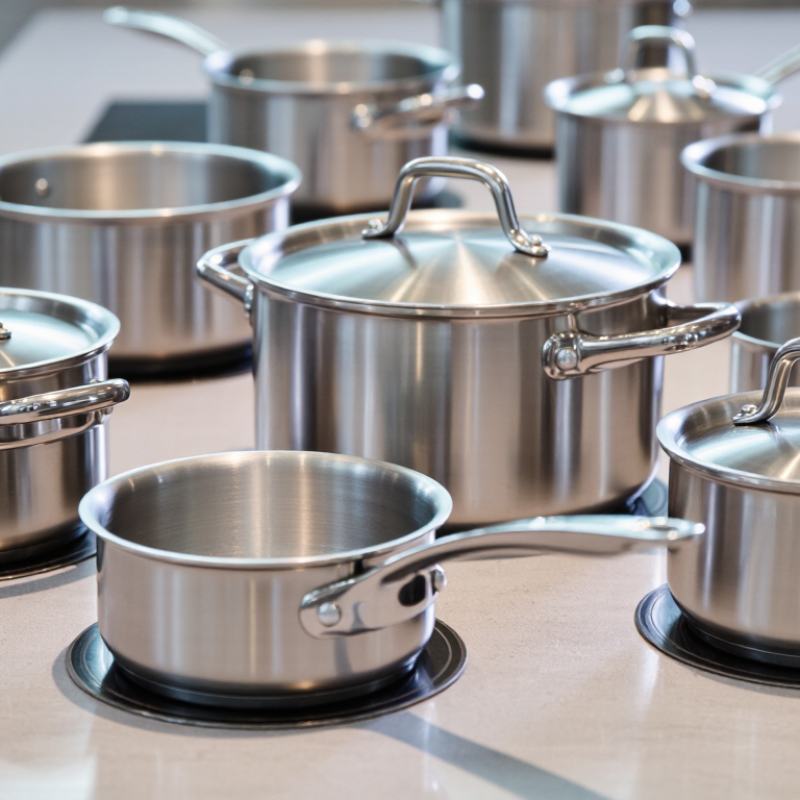
Wholesale buyers usually compare stainless steel casserole pots by shape, capacity, and heat construction. Straight-sided casseroles offer even cooking and easy stacking, making them practical for retail kitchens. Deep casserole pots provide extra height for soups, stews, and large-batch meals. Wide casseroles evaporate liquid faster and suit braising or sauce preparation.
Construction matters more than appearance. Tri-ply pots combine stainless steel with an aluminum core for responsive, balanced heating. Encapsulated-base models concentrate heat through a bonded bottom and can reduce production costs. Heavy-gauge pots feel durable, but weight alone does not prove uniform heating. Check the base thickness, wall finish, and lid fit. Small details matter.
Wholesale buyers should also review capacity ranges, handle strength, induction compatibility, and carton protection. A polished surface may attract shoppers, while a brushed finish can hide marks during frequent use. I have found that tight lids reduce cooking loss and improve customer satisfaction. Not every size sells equally. Testing a mixed sample order can reveal awkward handles, unstable lids, or poor stacking before volume purchasing. Specification sheets should state steel grade, dimensions, usable capacity, and food-contact suitability. Some suppliers describe capacity by the rim, which can mislead buyers. Always verify the working volume.
Key Materials, Grades, and Construction Features
Top Stainless Steel Casserole Pots for Wholesale Buyers?
Key Materials, Grades, and Construction Features
Wholesale buyers should start with the steel grade, not the polished surface. Grade 304, often labeled 18/8 or 18/10, offers strong corrosion resistance for everyday cooking. Grade 316 handles salty or acidic environments better, but it costs more. Grade 430 is magnetic and budget-friendly, yet it generally provides lower corrosion resistance. Grade 201 may reduce cost, although its performance can vary between suppliers.
Construction affects cooking results and product lifespan. A thick aluminum core improves heat distribution across the base. Encapsulated bases support induction use and reduce hot spots. Fully clad walls usually offer more even heating, but they can increase weight and production costs. A thicker wall is not automatically better. Excess weight may discourage daily use.
Check the details closely. Smooth internal welds prevent food from collecting in narrow seams. Secure handles should resist twisting during lifting. Lids need stable rims and controlled steam release. Ask suppliers for steel certificates, thickness tolerances, surface-finish samples, and batch testing records. Saltwater and acidic-food tests can reveal weaknesses that visual inspection misses. Small dimensional differences matter during stacking and packaging. Some buyers focus heavily on grade labels, then overlook warped bases or loose handles. That is an expensive mistake. Even reliable specifications deserve physical verification before a large order.
How to Evaluate Capacity, Compatibility, and Performance
For wholesale buyers, a stainless steel casserole pot should be judged by working capacity, not catalog volume alone. A six-liter pot may hold only four liters safely when soup rises during boiling. Measure the usable fill line and check the lid clearance. Consider your customers’ kitchens, too. A 20-centimeter base suits compact burners, while a wider base improves batch cooking. I have found that awkward proportions create more complaints than small capacity differences. That finding deserves a second look.
Check compatibility across gas, electric, ceramic, and induction cooking. A magnetic test can confirm induction suitability, but it cannot prove even heating. Ask for base construction details and independent heat-distribution data. Thick, flat bases usually reduce hot spots and warping. Handles should stay secure after repeated lifting, even with a full load. Inspect welds, rivets, lid fit, and interior polishing on samples. One attractive sample proves little. Request repeated-use testing before placing a large order.
Tips: Compare usable capacity, base diameter, empty weight, and packed dimensions in one sheet. Test three samples from different cartons. Fill each to the intended level, simmer for 30 minutes, and check the handles, lid movement, and base flatness. Record results with photographs. If specifications seem vague, pause. A low price can hide inconsistent steel thickness or costly returns.
Top Stainless Steel Casserole Pots for Wholesale Buyers? - How to Evaluate Capacity, Compatibility, and Performance
| Product Configuration |
Nominal Capacity |
Typical Diameter |
Recommended Serving Use |
Common Construction |
Cooktop Compatibility |
Oven Suitability |
Wholesale Evaluation |
| Compact casserole pot |
2.0–2.5 L |
18–20 cm |
1–2 people |
18/10 stainless-steel cooking body with a bonded heat-distribution base |
Gas, electric, ceramic, and induction when the base is magnetic |
Usually suitable; verify lid and handle limits |
Good entry-level size |
| Medium everyday casserole pot |
3.5–4.0 L |
20–22 cm |
2–4 people |
18/10 or 18/8 stainless steel with an aluminum-core encapsulated base |
All major domestic cooktops if the base is induction-ready |
Commonly suitable up to the rated temperature |
Best general-purpose option |
| Family casserole pot |
5.0–6.0 L |
24–26 cm |
4–6 people |
Thicker stainless-steel walls with a multi-layer thermal base |
Gas, electric, ceramic, and induction with a flat magnetic base |
Suitable for oven finishing when handles are oven-safe |
Strong retail demand |
| Large stock casserole pot |
7.0–8.0 L |
26–28 cm |
6–8 people |
Heavy-gauge stainless steel with a reinforced, impact-resistant base |
All cooktops when induction compatibility is confirmed by testing |
Check full-pot weight and handle construction |
Suitable for family and catering sales |
| Extra-large catering casserole pot |
10.0–12.0 L |
30–32 cm |
8–12 people |
Commercial-gauge stainless steel with a thick, encapsulated heat base |
Best verified for gas, electric, and commercial induction equipment |
Confirm oven dimensions and maximum load |
Higher logistics and storage needs |
| Multi-size set |
2.0, 3.5, and 5.0 L |
18–24 cm |
Flexible household use |
Matching stainless-steel bodies with compatible lids and layered bases |
Confirm that every pot in the set has an induction-compatible base |
Check the lowest-rated component |
Efficient for gift and assortment programs |
Wholesale inspection checklist:
Confirm actual brim capacity and usable capacity, stainless-steel grade, base flatness, induction response, wall and base thickness, lid fit, handle fastening, oven-temperature rating, dishwasher guidance, packaging dimensions, and carton quantity before placing a bulk order.
Wholesale Quality Standards, Certifications, and Customization Options
WWholesale casserole pots should be assessed as food-contact equipment, not simply as polished kitchenware. World Stainless reported 58.4 million tonnes of stainless steel production in 2023, showing a mature, standardized material supply chain. Yet material grade still matters. Ask for mill certificates, heat numbers, and independent composition testing. For everyday cooking, 304 stainless steel is common. Grade claims without traceability deserve skepticism.
The ISO Survey 2022 recorded 1,265,216 ISO 9001 certificates worldwide. That figure signals wide adoption, not automatic product quality. Require a current certificate, defined scope, issuing body, and factory address. For export orders, confirm food-contact documentation for the destination market. Check EU Framework Regulation 1935/2004, national requirements, or applicable U.S. food-contact rules. Ask for migration or leaching reports from an accredited laboratory. A certificate alone is not enough.
Customization should be written into a controlled specification. Define body thickness, base construction, induction performance, handle attachment, lid fit, surface finish, carton testing, and acceptable defects. Request samples from the same production line. Check them cold and hot. Factory evaluations often reveal attractive samples failing at rivets after repeated heating. This is easy to overlook. Agree on pre-shipment inspection, batch records, corrective-action timing, and retention samples. Small variations can become expensive returns.
Comparing Suppliers, Pricing, Minimum Orders, and Delivery Terms
Wholesale buyers should compare more than unit price when selecting stainless steel casserole pots. Suppliers using 304 steel, consistent wall thickness, and induction-ready bases may charge more initially. Ask for mill certificates, food-contact test records, sample measurements, and packed-carton photos. The International Stainless Steel Forum reported 58.4 million tonnes of stainless crude steel production in 2023, a 5.2% annual decline. Large supply does not guarantee consistent cookware quality. Price is not enough.
Request a landed-cost sheet covering the pot, lid, polishing, carton, inland freight, and inspection. Compare identical specifications, including capacity, steel grade, gauge, handle construction, and finish. A low quotation may exclude tooling or export packing. Minimum orders often change with customization. Stock designs may accept 100 units, while engraved logos and retail boxes can require 500 or more. Request price tiers at 100, 500, and 1,000 units. The 1,000-unit offer may look efficient, but it can trap cash when demand is untested.
Delivery terms need equal attention. Under Incoterms 2020, confirm whether the quote is EXW, FOB, CIF, or DDP. Clarify insurance, customs clearance, and destination charges in writing. Separate production time from sea transit time. UN Comtrade classifies many stainless household articles under HS 732393, helping buyers compare trade flows and supplier markets. Add a seven-to-fourteen-day buffer for inspection and port delays. That may seem excessive. Late seasonal stock costs more than modest freight savings.
Top Stainless Steel Casserole Pots for Wholesale Buyers
Typical wholesale benchmarks for 24 cm, 304 stainless steel casserole pots with lids. Prices are estimated per unit in USD; final quotations depend on thickness, handle design, packaging, certification, and order volume.
Larger-volume suppliers generally offer lower unit prices but require higher minimum orders. Smaller-batch programs reduce inventory risk and usually provide shorter production lead times, while standard production terms commonly require a 30% deposit and balance before shipment.
FAQS
Straight-sided pots cook evenly and stack neatly. Deep pots suit soups, stews, and large batches. Wide pots evaporate liquid faster. The best shape depends on customer cooking habits.
Tri-ply construction combines stainless steel with an aluminum core for balanced heating. Encapsulated bases focus heat through a bonded bottom. Heavy pots may feel durable, but weight does not prove even heating. Check the base thickness and wall finish.
Check handle strength, lid fit, working capacity, and stacking stability. Test a mixed sample order first. Small details matter. Awkward handles and loose lids can create returns.
Ask for usable capacity, not only rim capacity. A pot advertised as eight liters may hold less during safe cooking. Measure the interior with water. The specification sheet should show dimensions and working volume.
A polished finish can attract shoppers in retail displays. A brushed finish may hide fingerprints and small marks better. Neither finish guarantees stronger construction. Appearance can mislead buyers.
Request steel-grade records, food-contact test documents, sample measurements, and packed-carton photos. Confirm induction compatibility in writing. These records expose specification gaps before payment. They do not replace physical inspection.
Compare the full landed cost, including lids, polishing, cartons, inland freight, and inspection. Match capacity, steel grade, gauge, handles, and finish. A low quote may exclude export packing or tooling. Price is not enough.
Request price tiers for 100, 500, and 1,000 units. Large orders may lower unit cost but tie up cash. Confirm whether terms are EXW, FOB, CIF, or DDP. Add seven to fourteen days for inspection and port delays. I might underestimate delays sometimes.
Conclusion
Choosing the right stainless steel casserole pots for wholesale requires more than comparing surface appearance and quoted prices. Buyers should first review available types, including single-serving, family-size, deep, induction-ready, and stackable designs. Material grade, wall thickness, base construction, handle attachment, lid fit, heat distribution, corrosion resistance, and ease of cleaning all influence long-term performance. Capacity should match the intended market, while compatibility with induction, gas, electric, and oven cooking can broaden product appeal.
Wholesale evaluation should also include consistent manufacturing quality, food-contact safety documentation, inspection procedures, packaging standards, and any applicable certifications. Customization options may cover dimensions, finishes, lids, handles, packaging, and labeling. When comparing suppliers, assess total cost rather than unit price alone, including minimum order quantities, sample policies, tooling charges, payment terms, production schedules, shipping arrangements, and after-sales support. A dependable supplier should communicate clearly, maintain stable quality across batches, and provide delivery terms that support reliable inventory planning.