Expert articles, wholesale sourcing guides, product developments, and technical manufacturing trends from Adil Stainless Steel.
Choosing tri-ply stainless steel cookware for wholesale requires more than comparing prices and polished product photos. Buyers must examine construction, performance, supplier reliability, and long-term value. A well-made tri-ply design usually combines stainless steel with an aluminum or copper core, helping distribute heat more evenly across the pan. This matters in busy kitchens where uneven heating can scorch sauces or leave vegetables partly raw.
Begin with the cookware’s material specifications and manufacturing details. Confirm the stainless steel grade, layer structure, wall thickness, handle attachment, lid fit, and surface finish. Request samples before placing a large order. Hold each piece, test the balance, and inspect the cooking surface under strong light. Small welding marks may reveal inconsistent workmanship. They should not be ignored.
Wholesale buyers also need practical evidence. Ask suppliers about production capacity, quality-control procedures, packaging strength, replacement policies, and delivery records. Certifications and test reports can support trust, but documents should match the actual products supplied. A factory visit, video inspection, or independent product testing may provide stronger reassurance. Still, no supplier is perfect. Even experienced manufacturers can face delays, batch differences, or packaging damage.
Think about the final customer. A restaurant may value thick bases and durable handles, while a retail buyer may prefer lighter pieces with attractive presentation. Induction compatibility, dishwasher guidance, oven temperature limits, and warranty terms should be clear. Cheap cookware can create expensive complaints. However, the highest price does not guarantee the best result. Compare verified performance, service, and consistency before deciding. Your first order should be treated as a measured trial, not an assumption of lifelong cooperation.
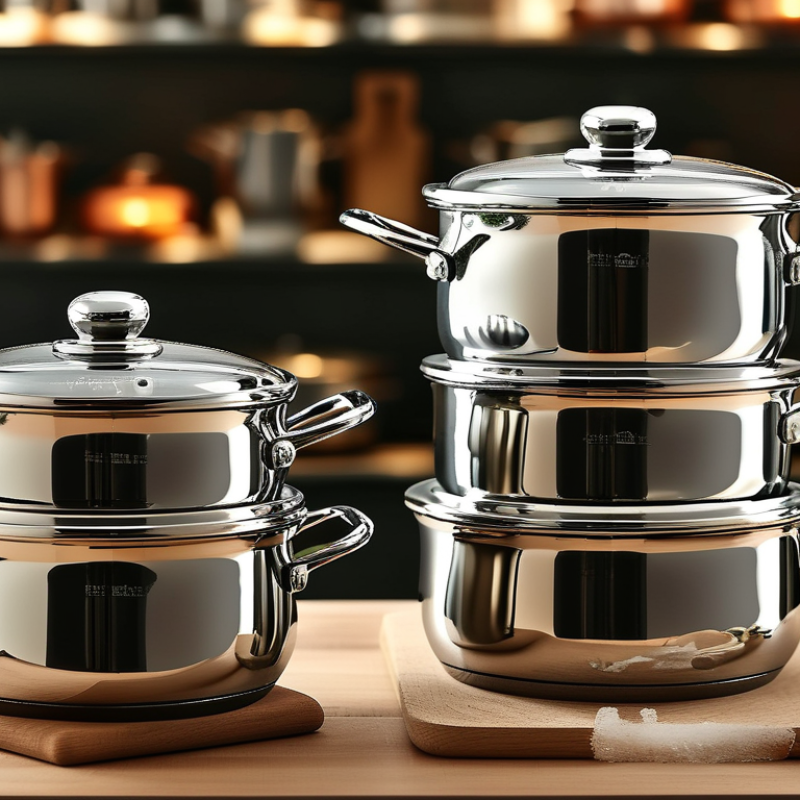
Tri-ply stainless steel cookware combines three bonded layers: stainless steel inside, an aluminum heat-conducting core, and stainless steel outside. The inner surface resists food reactions and staining. The aluminum core spreads heat faster than stainless steel alone. The outer layer supports durability and works with many induction cooktops.
Construction quality matters more than the word “tri-ply.” A thicker, continuous core usually reduces hot spots around a pan’s center. Check the rim and base cross-section, because some products use partial cladding instead of full sidewall coverage. The cooking surface should feel smooth, without sharp transitions or visible separation. According to the International Stainless Steel Forum, global stainless steel melt production reached about 58.4 million tonnes in 2023. That scale supports broad material availability, but it does not guarantee cookware quality.
Wholesale buyers should request heat-distribution tests, flatness checks, and corrosion-resistance documentation. A 2022 Allied Market Research report projected the global cookware market to reach about 25.9 billion dollars by 2031, increasing pressure on suppliers to prove consistency. Ask for measured core thickness, steel grade, handle-load testing, and induction performance. Do not rely only on polished packaging. In practical testing, place a thin layer of water over the base and observe boiling patterns. Uneven bubbling can reveal weak heat transfer. The test is simple. It is not perfect. Supplier data may also require independent verification before large-volume purchasing.
When choosing tri-ply stainless steel cookware for wholesale, inspect the material stack, not only the polished surface. A typical structure uses stainless steel inside and outside, with an aluminum core. ASM Handbook, Volume 2, reports thermal conductivity near 16 W/m·K for stainless steel, compared with about 205 W/m·K for aluminum. This difference explains why the core matters. It spreads heat across the base and reduces hot spots around the burner.
Thickness needs practical testing. Many commercial tri-ply pans use a total body thickness near 2.5 to 3.0 millimeters, but specifications vary by product. A thicker pan may store heat well, yet it can respond slowly during busy kitchen service. A thinner pan may heat quickly, but uneven cooking becomes more likely. I have seen attractive samples warp after repeated heating cycles. That weakness was invisible during showroom inspection. Request flatness checks, wall-thickness measurements, and heat-cycle records before placing a large order.
Heat distribution should be tested with a controlled burner and thermal imaging camera. The U.S. Department of Energy’s commercial food-service research identifies cooking equipment as a major energy-use category, so inefficient cookware can increase operating costs. Check temperature differences across the base, handle attachment quality, and lid fit. A useful target is stable heating without a sharp temperature ring near the center. It is not a perfect rule. Burner size, induction compatibility, and user technique can change results. Ask suppliers for ASTM or equivalent corrosion and durability test evidence, then repeat basic checks on random production samples.
Choosing tri-ply stainless steel cookware for wholesale starts with practical size planning. A balanced range should serve households, restaurants, and catering teams. Small saucepans of 1 to 2 quarts suit sauces, grains, and single servings. Medium 3 to 5-quart pieces handle vegetables, pasta, and family meals. Larger stockpots, often 8 quarts or more, support soups and batch cooking.
Shape affects storage, handling, and sales appeal. Straight-sided saucepans stack efficiently and offer stable heating across the base. Wide sauté pans provide more cooking surface for browning meat or reducing sauces. Stockpots need tall walls, strong handles, and a secure lid. Useful product types include frying pans, sauté pans, saucepans, Dutch ovens, and stockpots. Avoid building a range around one shape. Buyers often need complete cooking sets, not isolated pieces.
Tips: Compare usable capacity, not only listed volume. Check handle welds, lid fit, rim finishing, and base flatness. Ask for sample testing before placing a large order. Cook tomato sauce and simmer water in the samples. These simple tests reveal hot spots, difficult pouring, and weak handles. From wholesale checks, I have learned that attractive packaging cannot fix poor balance. I once underestimated lid storage, and the cartons occupied more warehouse space than expected. That mistake still influences my size forecasts. Leave room for regional cooking habits, because one assortment rarely fits every market.
| Product Type | Typical Wholesale Sizes | Common Shape | Approx. Capacity | Best Use | Recommended Tri-Ply Features | Wholesale Selection Notes |
|---|---|---|---|---|---|---|
| Fry Pan | 20, 24, 26, 28, 30, 32 cm | Round, shallow sides | 0.8–2.5 L | Frying, searing, sautéing, omelets | Aluminum core, flat base, rolled rim, stay-cool handle | 24–28 cm are versatile retail sizes; 30–32 cm suit family cooking and foodservice. |
| Saucepan with Lid | 14, 16, 18, 20 cm | Round, tall-sided | 1.0–3.5 L | Sauces, grains, reheating, small portions | Even sidewall heating, tempered glass or stainless-steel lid, pouring rim | 16–18 cm typically cover everyday household demand; verify lid interchangeability. |
| Sauté Pan | 24, 26, 28, 30 cm | Wide base, straight sides | 2.5–5.5 L | One-pan meals, braising, shallow frying | Large conductive base, helper handle, tight-fitting lid | A broad flat cooking surface adds versatility but requires stable, warp-resistant construction. |
| Stock Pot | 16, 20, 24, 28, 32 cm | Tall, cylindrical | 4–18 L | Soups, pasta, stocks, batch cooking | Reinforced base, strong side handles, vented lid, balanced weight | 20–24 cm work well for home kitchens; 28–32 cm target large families and commercial users. |
| Dutch Oven | 20, 24, 26, 28 cm | Wide, deep round or oval | 3–7 L | Braising, stews, baking, slow cooking | Heavy-gauge body, secure lid, broad base, oven-safe handles | Choose designs with manageable weight; large capacities increase freight and shelf-space costs. |
| Wok | 28, 30, 32, 34 cm | Round or flat-bottomed bowl | 3–6 L | Stir-frying, steaming, deep-frying | Rapid heat distribution, helper handle, compatible flat base where required | Flat-bottom models offer broader cooktop compatibility; confirm induction performance. |
| Griddle | 26 × 26, 28 × 28, 30 × 50 cm | Square or rectangular | Cooking surface product | Pancakes, grilled sandwiches, vegetables, meat | Rigid flat plate, grease channel, heat-resistant handles, stable underside | Rectangular formats maximize surface area but need adequate storage and packaging protection. |
| Milk Pan | 12, 14, 16 cm | Small, deep round body | 0.7–1.5 L | Heating milk, melting butter, small servings | Pouring spout, ergonomic handle, smooth interior finish | Compact size supports entry-level sets and small-kitchen assortments. |
| Cookware Set | 5, 7, 9, 12 pieces | Mixed round shapes | Combined set capacity | Complete kitchen preparation | Consistent tri-ply construction, nesting design, compatible lids | Standardize handles, finishes, lid sizes, and packaging to simplify inventory management. |
For wholesale buyers, tri-ply stainless steel cookware should be judged beyond its mirror finish. A typical structure uses stainless steel inside and outside, with an aluminum core for faster heat distribution. Check the base thickness, layer bonding, rim alignment, and handle welds. Uneven seams can trap food residue and increase returns.
The U.S. FDA Food Code 2022 requires food-contact surfaces to be smooth, corrosion-resistant, nonabsorbent, and easily cleanable. Request material certificates and test reports, not only supplier claims. Grade names can be confusing.
Safety documentation matters. NSF/ANSI 51 covers materials and finishes used in commercial food equipment, offering a useful benchmark for wholesale evaluation. Ask whether the finished cookware has passed migration, corrosion, and heat-cycle testing.
Also inspect lids, rivets, and internal corners. These small parts often fail first.
I still distrust perfect samples. Production batches can differ.
Tips:
Order samples from different lots. Test them on induction and gas. Measure flatness after heating. Ask for factory audit records, ISO 9001 evidence, corrective-action reports, and batch traceability. The 2023 Deloitte Global Chief Procurement Officer Survey reported that supply-chain disruption remains a major procurement concern, so supplier reliability deserves measurable checks. Confirm lead times, minimum order quantities, replacement policies, and inspection procedures in writing. A supplier that shares dated reports and accepts independent inspection is easier to trust. Price matters, but unstable quality costs more.
When buying tri-ply stainless steel cookware wholesale, compare more than the quoted unit price. A low offer may exclude lids, handles, polishing, inner markings, or export packaging. Ask for a written cost breakdown. It should show material grade, thickness, diameter, labor, packing, and delivery terms. For example, a 24-centimeter saucepan with a bonded aluminum core may cost more than a thinner pan, but it can heat more evenly. Request a sample and test its balance, rivets, handle temperature, and flatness on an induction surface. Small details matter.
Customization can include capacity, wall thickness, logo placement, handle shape, lid type, carton artwork, and barcode labels. Confirm which changes require new tooling. A laser mark may suit small runs, while stamped patterns usually need higher quantities. Ask whether sample fees return after mass production. They may not. That clause affects real margin. In my purchasing experience, I once focused on a lower pan price and overlooked custom cartons. The final packaging charge weakened the expected saving. That was avoidable.
Order requirements deserve equal attention. Check MOQ per size, mixed-model rules, payment stages, production lead time, inspection access, replacement policy, and shipping documents. A supplier may accept 500 pieces overall but require 300 pieces per diameter. Write tolerances into the purchase agreement, including scratches, warping, weld quality, and lid fit. Keep pre-shipment records with photos and measured samples. Do not rely only on a polished sample. Factory output can vary. Recheck pricing when steel costs, packaging, or freight change before confirming the order.
Typical wholesale benchmarks by product type, including estimated unit price, minimum order quantity, and standard customization flexibility.
Stock-style tri-ply frying pans generally offer the lowest entry price and order quantity. Saucepans and larger stockpots use more stainless steel and aluminum, so their unit prices and minimum order quantities are typically higher. Private-label packaging, laser logos, custom colors, and altered dimensions normally require higher quantities than standard products.
It uses three bonded layers: stainless steel, an aluminum core, and stainless steel outside. The inner steel resists staining and food reactions. The aluminum core spreads heat faster than stainless steel alone.
“Tri-ply” does not guarantee reliable performance. A thicker, continuous core can reduce hot spots near the pan’s center. Check the rim and base cross-sections. Some cookware has only partial sidewall cladding.
Many commercial pieces measure about 2.5 to 3.0 millimeters overall. Thicker cookware stores heat well but may respond slowly. Thinner cookware heats quickly but may cook unevenly. Measurements can vary.
Use a controlled burner and, if possible, thermal imaging. You can also spread a thin water layer across the base. Observe the boiling pattern. Uneven bubbles may reveal weak heat transfer. This simple test is imperfect.
Request core-thickness measurements, steel-grade details, flatness checks, and heat-cycle records. Ask for handle-load testing and induction performance evidence. Corrosion and durability reports are also useful. Independent verification is wiser for large orders.
One- to two-quart saucepans suit sauces, grains, and single servings. Three- to five-quart pieces handle vegetables, pasta, and family meals. Stockpots of eight quarts or more support soups and batch cooking. Plan for local cooking habits.
Consider frying pans, sauté pans, saucepans, Dutch ovens, and stockpots. Wide sauté pans provide more browning space. Tall stockpots need strong handles and secure lids. A single shape rarely serves every buyer.
Check usable capacity, handle welds, lid fit, rim finishing, and base flatness. Cook tomato sauce and simmer water in sample pieces. These tests may reveal hot spots, poor pouring, or weak handles. Attractive packaging cannot repair poor balance. I once underestimated lid storage. The cartons used more warehouse space than expected.
Choosing tri-ply stainless steel cookware for wholesale requires a clear understanding of its three-layer construction, typically combining stainless steel with a heat-conductive core and a durable cooking surface. Buyers should compare material grades, wall thickness, weight, and heat distribution to ensure reliable performance, even cooking, and long-term durability. The cookware should also be easy to clean, resistant to corrosion, and suitable for the intended cooking environment.
Wholesale selection should match customer demand through practical sizes, shapes, and product types, such as saucepans, frying pans, stockpots, and complete sets. Quality checks should include secure handles, well-fitted lids, smooth edges, stable bases, and compliance with applicable food-contact and safety standards. Supplier reliability is equally important, so evaluate production consistency, inspection procedures, communication, lead times, and after-sales support. Finally, compare total pricing, minimum order quantities, packaging, customization possibilities, samples, and payment terms before placing an order. A balanced decision will help achieve dependable quality and sustainable wholesale value.