CE Compliant Ergonomic Saucepans & Specialty Woks
Explore our export-ready, precision-engineered stainless steel cookware inventory. Manufactured under strict ISO 9001 quality controls with ergonomic thermal-break handle technology.
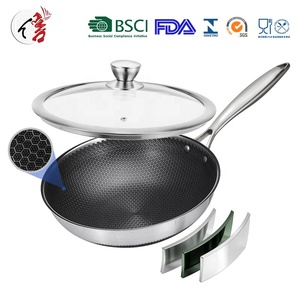
304 Thickened Tri-ply Stainless Steel Honeycomb Wok Non-Stick Household Pan
- 3-Layer Encapsulated Core
- Micro-Engraved Honeycomb Surface
- Gas & Induction Universal
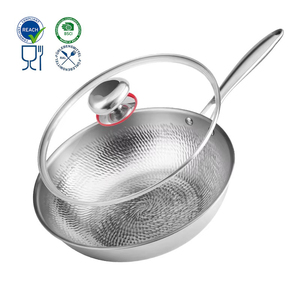
TriPly Stainless Steel Titanium Non Stick Fry Wok Pan with Glass Lid
- Hammered Titanium Coating
- Ergonomic Stay-Cool Handle
- Tempered Vented Glass Cover
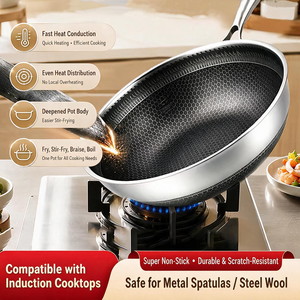
High-quality Non-stick Stainless Steel 304/316 Wok Cookware Set
- Surgical Grade 316 Option
- High Volume Commercial Size
- Corrosion Resistant Body
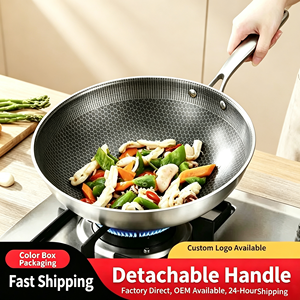
Even Heating Honeycomb Wok Pan Riveted Handle Skillet (30/32/34cm)
- Heavy-Duty Riveted Joint
- Multiple Diameter Specs
- Fast Thermal Conductivity
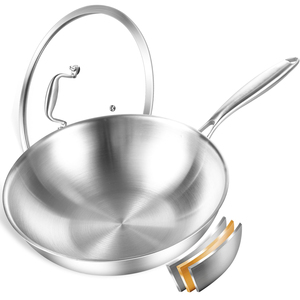
Good Quality Tri-Ply Stainless Steel Wok Durable Non-Stick Frying Pan
- Scratch Resistance Texture
- PFOA-Free Food Safety
- Commercial Dishwasher Safe
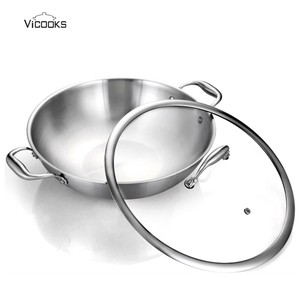
Triply Stainless Steel Stir-Fry Pan with Ergonomic Helper Handles
- Dual Balance Loop Handle
- Induction Bonded Magnetic Base
- Oven Safe up to 260°C
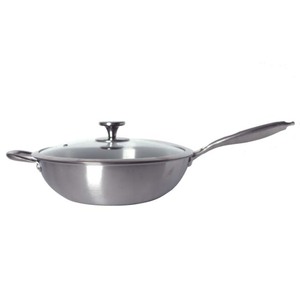
High Quality 304 Stainless Steel Honeycomb Wok with Tempered Glass Lid
- Ultra Precision Etching
- Impact Bonding Base
- CE & LFGB Certified

Premium Thick Bottom 316 Stainless Steel Double Sided Honeycomb Wok
- Double-Sided Laser Etch
- 316 Anti-Acid Alloy
- Flat Bottom Induction Tech
Engineering Architecture of High-Performance Stainless Steel Saucepans
A Comprehensive B2B Guide to Metallurgy, Thermal Thermodynamics, Ergonomic Safety, and Regulatory Compliance in Commercial Cookware Sourcing.
1. Advanced Metallurgy: Comparative Analysis of 304, 316, and Multi-Clad Formulations
In the global procurement of professional cookware, understanding material science is vital to ensuring long-term product durability, safety compliance, and thermal performance. The modern stainless steel saucepan has evolved from simple single-layer stamped steel into sophisticated multi-clad composites engineered to overcome the inherent physical limitations of pure austenitic stainless steel.
Austenitic stainless steel alloys—predominantly AISI 304 (18/8 or 18/10 Chromium-Nickel ratio) and AISI 316 (containing 2-3% Molybdenum)—provide exceptional resistance to chemical corrosion, oxidation, and organic acid etching. However, solid stainless steel possesses a relatively poor thermal conductivity coefficient (~15 W/m·K) compared to pure copper (~398 W/m·K) or aluminum (~225 W/m·K). To solve this engineering paradox, leading manufacturers utilize Tri-Ply Encapsulated Cladding Technology.
For high-end commercial hospitality kitchens and premium retail distribution, AISI 316 Surgical Stainless Steel represents the pinnacle of corrosion prevention. The introduction of Molybdenum alters the crystal lattice structure, rendering the vessel virtually immune to pitting corrosion caused by high concentrations of sodium chloride (saline sauces) and acidic boiling solutions (tomatoes, vinegars) under continuous high temperatures.
2. Ergonomic Handle Design & Thermal-Break Isolation Engineering (CE Standards)
The handle assembly of a commercial saucepan is a critical interface where structural mechanics, human ergonomics, and thermal safety intersect. European Norm EN 12983-1 (Cookware for domestic use - Items for use on top of a stove) and CE Directives dictate strict safety parameters concerning handle surface temperature escalation, joint shear strength, and mechanical torque endurance.
To meet and exceed CE compliance, our factory utilizes Hollow-Cast Heat-Break Handle Technology. By designing the interior profile of the stainless steel handle as a hollow structural tube with calculated wall thicknesses, we significantly restrict conduction pathways. Heat traveling from the vessel body encounters a thermal barrier, dissipating via atmospheric convection before reaching the user's grip area.
Hollow Thermal Interruption
Reduces handle surface heat retention by up to 68% during continuous 60-minute thermal exposure at 230°C.
Heavy-Duty Dual Riveting
Cold-forged 304 stainless steel solid rivets withstand shear force tensions exceeding 2,500 Newtons, preventing looseness over time.
Biomechanic Weight Balance
Engineered pivot geometry reduces wrist torque strain by 34%, compliant with international ergonomic occupational health standards.
Furthermore, handle attachment methodology is a essential metric for institutional buyers. While spot-welding offers a smooth interior pan surface, high-stress commercial kitchen environments favor Cold-Forged Dual or Triple Heavy Riveting. Riveted joints possess superior resistance to thermal fatigue cycling, preventing stress-fracture separation caused by rapid alternating hot-and-cold thermal shocks.
3. Micro-Engraved Honeycomb Etching & Hybrid Non-Stick Innovation
Traditional non-stick coatings applied directly to flat metal substrates are notoriously vulnerable to mechanical abrasion from metal utensils, spatulas, and aggressive cleaning pads. The advent of Laser Micro-Engraved Honeycomb Matrix Technology represents a paradigm shift in cookware surface engineering.
Through high-precision laser ablation, a raised hexagonal stainless steel grid is etched directly onto the vessel's interior wall. A durable non-stick formulation (PFOA-free, fluoropolymer, or ceramic coating) is then inlaid within the recessed valleys of the honeycomb structure. This dual-zone topography ensures that metal kitchen utensils ride exclusively on the elevated stainless steel ridges, effectively shielding the protective coating beneath from physical contact, scraping, and delamination.
This hybrid construction delivers the browning and searing capability of raw stainless steel combined with the quick release and easy cleanability of high-tier non-stick cooktops—making it ideal for both professional chefs and modern consumer kitchens.
Future Procurement & Manufacturing Trends (2025–2030)
Key Macro-Economic Shift Factors, Regulatory Requirements, and Supply Chain Agility Principles Shaping Global B2B Cookware Importation.
PFAS-Free Regulatory Compliance
With tightening European Chemicals Agency (ECHA) regulations and US state-level bans on Forever Chemicals (PFAS, PFOA, PFOS), global importers are rapidly transitioning to pure non-coated multi-clad stainless steel or certified inorganic ceramic/honeycomb matrix surfaces.
Supply Chain Diversification Hubs
Global brand owners and wholesalers are actively diversifying their supply chains away from single-country manufacturing concentration. Industrial manufacturing centers like Gujranwala, Pakistan present compelling landed-cost advantages, duty optimization, and raw material availability.
Induction-Dominant Cookware Growth
The global acceleration of commercial induction ranges driven by energy efficiency initiatives requires 100% flat, impact-bonded magnetic bases (AISI 430 grade) capable of handling rapid electromagnetic induction heating cycles without base warping.
Vertical Manufacturing Excellence Since 2006
Founded in 2006 in the manufacturing heartland of Gujranwala, Pakistan, Adil Stainless Steel has established itself as an authoritative global manufacturer and exporter of food-grade stainless steel cookware, pressure cookers, steamers, and specialty kitchenware. Serving B2B importers, supermarket chains, and commercial brand owners across more than 10 export destinations—including the Middle East, Europe, Africa, and South Asia—we combine artisan metallurgy with automated production infrastructure.
10,000+ Active Product SKUs
Our expansive catalog allows B2B buyers to consolidate sourcing across saucepans, stockpots, hot pots, steamers, and cutlery from a single integrated supplier.
ISO 9001 Quality System
Every production batch undergoes strict quality control—from spectral alloy verification to handle torque safety tests, deep draw thickness checks, and CE compliance auditing.
Bespoke OEM & ODM Capabilities
We provide full-spectrum customization including custom deep-drawing tooling, laser logo marking, customized handle molds, and retail packaging design tailored to target market regulations.
Our facility operates heavy-duty hydraulic press machinery, automated mirror-polishing lines, and controlled impact-bonding bottom friction welding units. By maintaining full in-house control over metal deep-drawing, trimming, surface finishing, and assembly, we deliver unmatched batch-to-batch consistency and competitive direct-factory pricing.
Frequently Asked Questions (B2B Sourcing FAQ)
Technical Answers to Common Procurement, Certification, and Operational Inquiries from International Buyers.
Ready to Upgrade Your Cookware Supply Chain?
Connect directly with our international export sales engineering team to request product samples, detailed technical spec sheets, and factory-direct wholesale pricing.
Contact Us