High-Performance Clad Stainless Steel Cookware Series
Direct factory supply of multi-ply clad stir-fry woks, frying pans, and cookware sets engineered for high-frequency induction hobs and professional commercial kitchens.
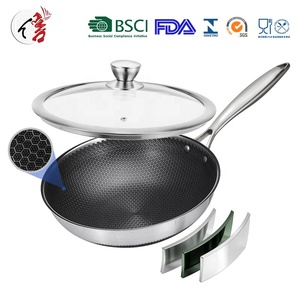 Top Rated
304 Thickened Tri-ply Stainless Steel Honeycomb Wok Non-Stick Household Pan Universal for Induction Cooker & Gas Stove
Inquire Now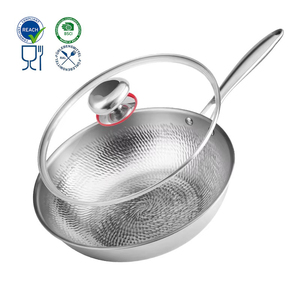 Titanium Series
TriPly Stainless Steel Titanium Non Stick Fry Wok Pan Non-stick Induction Hammered Titanium Stainless Steel Wok with Glass Lid
Inquire Now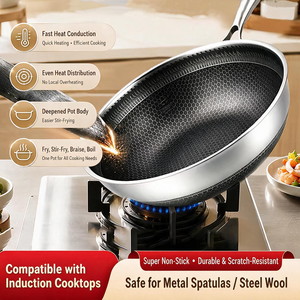 316 Surgical Steel
High-quality Non-stick Stainless Steel 304/316 Wok with Glass Cover 18L Capacity Gas & Induction Compatible Cookware Set
Inquire Now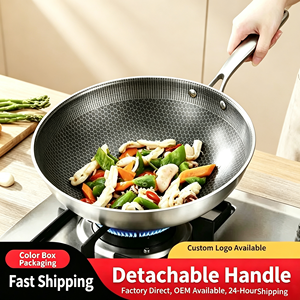 Commercial Grade
Even Heating Honeycomb Wok Pan 30/32/34cm Riveted Handle Stainless Steel Skillet for Gas Induction Stove
Inquire Now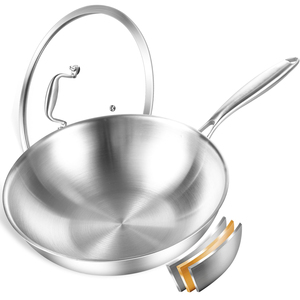 Export Wholesale
Good Quality Tri-Ply Stainless Steel Wok Durable Cookware Non-Stick Frying Pan for Cooking
Inquire Now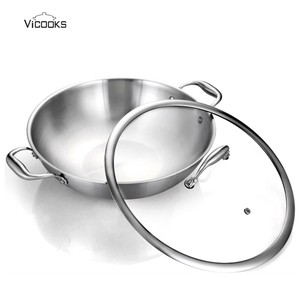 Dual Handle
Triply Stainless Steel Woks Stir-Fry Pan with Helpers Induction Wok for Household
Inquire Now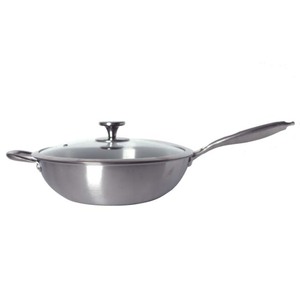 Tempered Lid
High Quality 304 Stainless Steel Honeycomb Wok Stirfry Pan Tempered Glass Lid Induction Bottom
Inquire Now Double Sided Etched
Premium Thick Bottom 316 Stainless Steel Double Sided Non-Stick Flat Bottom Wok Honeycomb Design with Glass Lid for Home Use
Inquire NowMetallurgical Fundamentals & Cladding Technology in Modern Cookware Manufacturing
Understanding why high-tier commercial buyers and premium retail brands are transitioning from traditional encapsulated-disc cookware to full-body clad stainless steel systems.
In the evolving landscape of professional and consumer culinary equipment, clad stainless steel cookware represents the pinnacle of thermal efficiency and mechanical durability. Unlike conventional single-ply cookware that relies on a hot-stamped impact-bonded disc at the base, fully clad cookware utilizes advanced continuous metallurgical bonding. Through high-pressure roll-bonding processes, multiple distinct metal alloys are permanently fused into a single structural sheet prior to deep-drawing into finished vessels.
The 3-Ply & 5-Ply Material Composition Architecture
The engineering efficiency of clad cookware lies in strategic multi-alloy layering. Stainless steel is renowned for chemical inertness, high tensile strength, and corrosion resistance, but it exhibits poor thermal conductivity ($K \approx 15 \text{ W/m}\cdot\text{K}$). Conversely, pure aluminum ($K \approx 237 \text{ W/m}\cdot\text{K}$) and copper ($K \approx 401 \text{ W/m}\cdot\text{K}$) offer extraordinary thermal diffusion but lack chemical stability against acidic food matrices. Clad composite technology bridges this gap seamlessly.
Interior Layer: Food Contact Zone
Engineered using premium Austenitic Stainless Steel (SUS 304 / 18/8 or SUS 316L / 18/10+Mo). 316L is infused with 2-3% Molybdenum, providing superior resistance to pitting corrosion induced by chlorides, sea salts, and organic food acids during high-temperature boiling.
Core Layer: Thermal Dispersion Grid
Constructed with high-purity Alloy Al-1050 or Al-3003 Aluminum, or integrated pure copper cores. This intermediate layer spreads thermal energy rapidly across the sidewalls as well as the base, eliminating localized hot spots that cause food scorching.
Exterior Layer: Induction Compatibility
Formulated from Ferritic Stainless Steel (SUS 430 / 18/0). High magnetic permeability ensures immediate energy absorption on commercial 2000W-5000W high-frequency induction ranges while maintaining structural stability against thermal warping.
Technical Comparison: Clad Cookware Configurations
| Cladding Structure | Layer Breakdown (Inside to Outside) | Thermal Conductivity Rate | Structural Deformation Risk | Primary B2B Target Market |
|---|---|---|---|---|
| Tri-Ply (3-Ply Full Body) | 304/316 Stainless Steel + Al 3003 Core + 430 Magnetic Steel | Fast (Approx. 210 W/m·K effective) | Extremely Low (< 0.05% thermal drift) | Mass Retail, Premium Household, Mid-tier HORECA |
| 5-Ply Heavy Duty | 304 Steel + Pure Al + Al Alloy + Pure Al + 430 Steel | Ultra-Uniform Heat Storage Matrix | Zero Deformation under intense commercial heat | Professional Commercial Kitchens, Executive Chef Lines |
| Copper-Core 5-Ply | 316L Steel + Al 1050 + C11000 Pure Copper + Al 1050 + 430 Steel | Maximum Diffusion (Approx. 360 W/m·K) | Negligible (< 0.01%) | High-End Luxury Culinary Brands, Precision Cooking Equipment |
| Laser-Etched Tri-Ply | 304/316 Steel + Al Core + 430 Steel + Micro-Laser Honeycomb Mesh | Fast Heat Transmission with Physical Non-Stick Protection | Zero Structural Warping | E-commerce Top Sellers, Direct-to-Consumer (DTC) Brands |
Future Sourcing Trends in the Clad Stainless Steel Sector
Key market drivers shaping international buyer procurement criteria, regulatory compliance, and product differentiation over the next decade.
1. Shift Toward PFOA-Free & Mechanical Non-Stick Surfaces
Global consumer awareness regarding PFAS and PTFE chemical hazards has accelerated demand for micro-laser etched honeycomb stainless steel structures. By creating raised stainless steel ridges over a recessed coating matrix, cookers withstand metal utensils while achieving effortless food release without hazardous chemical degradation.
2. Adoption of Bio-Compatible Titanium Cladding
Leading OEMs are integrating Titanium-infused outer and inner layers into tri-ply woks. Titanium cladding reduces total cookware weight by up to 22% compared to traditional steel while offering total immunity against salt-water corrosion and alkaline etching in commercial dishwashers.
3. ESG, Carbon Traceability & CBAM Compliance
European and North American importers require stringent environmental reporting. Modern Chinese manufacturers must provide full raw material supply chain transparency, utilizing recycled steel inputs (up to 75% scrap recycling rates) and energy-efficient induction annealing furnaces to comply with upcoming carbon tax tariffs.
Why Global Brands Partner With Our Manufacturing Infrastructure
Combining 18+ years of metallurgical expertise, state-of-the-art deep drawing press lines, and uncompromising quality assurance protocols.
Advanced Hydraulic Deep Drawing
Our facility operates ultra-heavy 1600-ton to 2500-ton double-action hydraulic presses. This guarantees precise, uniform material stretching across complex wok curves without micro-fracturing the internal aluminum core layer.
Rigorous QA & Laboratory Testing
Every batch undergoes rigorous quality assurance testing: 48-hour ASTM B117 salt spray corrosion tests, thermal shock cycles (heating to 350°C and quenching in 15°C water), and handle rivet shear tests exceeding 2.5 kN load capacity.
Turnkey OEM / ODM Solutions
We provide complete private label engineering: from custom die development, ergonomic hollow-cast stainless handle casting, laser logo etching, to drop-test approved 7-ply mail-order packaging for Amazon & DTC sellers.
Standardized B2B Procurement & Manufacturing Process
Frequently Asked Procurement & Technical Questions
Critical information for procurement managers, brand owners, and global distributors seeking reliable manufacturing partners in China.
Q1: What is the functional difference between full-body tri-ply clad cookware and impact-bonded encapsulated bottom cookware?
Impact-bonded cookware only features an aluminum layer welded to the bottom of the pot. Heat transfers upward slowly, creating severe temperature drops along the sidewalls. Full-body tri-ply clad cookware has the aluminum core extending continuously from the center base all the way up to the top rim. This guarantees 360-degree uniform heat diffusion, eliminating side scorching and reducing overall cooking energy consumption by up to 30%.
Q2: Why is SUS 316L stainless steel superior to SUS 304 for premium cookware lines?
While SUS 304 (18/8) is food-grade and highly durable, SUS 316L (18/10) contains added Molybdenum (2-3%). This element significantly increases chemical resistance against chloride ions found in salt, soy sauce, and acidic broths. SUS 316L cookware exhibits superior pitting corrosion resistance, maintains its pristine mirror polish longer, and satisfies medical-grade hygiene expectations for high-end consumer markets.
Q3: How does your manufacturing process prevent delamination of clad layers under extreme thermal shock?
Delamination occurs when raw clad sheets suffer from inadequate bonding pressure during metallurgical rolling. We source exclusively premium-grade cold-rolled clad coils from accredited steel mills. During manufacturing, our pressing dies are engineered to prevent layer shearing. Furthermore, every batch passes thermal cycle stress tests (repeatedly heating to 300°C followed by immediate cold water immersion) to ensure zero structural separation over decades of use.
Q4: What international food contact certifications do your products hold for European and US export?
Our products fully comply with global food safety standards, including FDA 21 CFR 175.300 (United States), LFGB Section 30 & 31 (Germany), EU Framework Regulation (EC) No 1935/2004, and DGCCRF (France). All non-stick micro-coatings used in our honeycomb woks are certified 100% PFOA-free, PFOS-free, lead-free, and cadmium-free.
Q5: What are the Minimum Order Quantities (MOQ) and production lead times for OEM private label orders?
Standard MOQs for stocked models start at 500 units per size. For fully customized OEM orders (custom die molds, custom handle castings, specialized laser etching, branded color boxes), our standard MOQ is 1,000 units. Production lead time is typically 30 to 40 days following sample approval and deposit confirmation.
Q6: Can your factory support custom laser-etched honeycomb pattern design and brand logo engraving?
Yes. We feature high-precision CNC laser micro-etching equipment. We can customize the physical honeycomb mesh density, integrate your brand logo directly into the center non-stick cooking grid, laser-mark capacity scale lines on inner walls, and stamp your brand logo onto the base exterior and handle rivets.
Accelerate Your Cookware Brand With China's Leading Clad Manufacturer
Whether you are scaling an established kitchenware brand, sourcing for commercial hotel chains, or launching an innovative DTC product line, our engineering team provides direct factory pricing, rapid prototyping, and uncompromised quality.