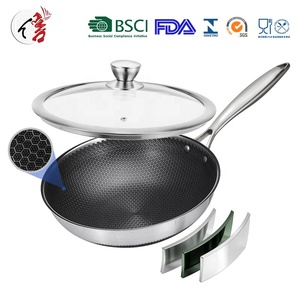
 Tri-Ply Honeycomb
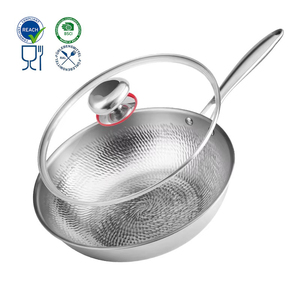 Titanium Hybrid
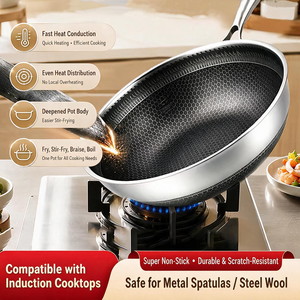 Commercial 18L
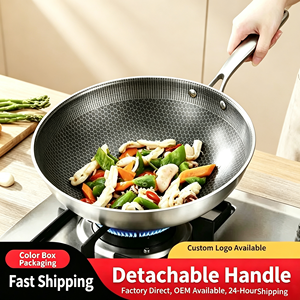 Multi-Size Series
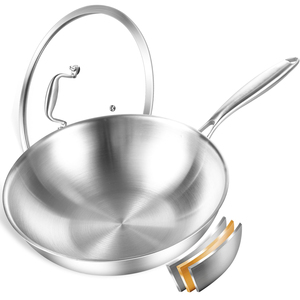 OEM Wholesale
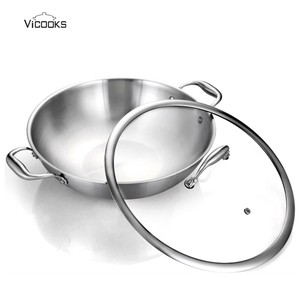 Dual Handle Design
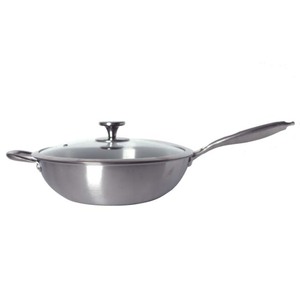 Tempered Lid Set
 Double-Sided Honeycomb
Engineering Whitepaper: Metallurgical Foundations & Cladding Science of Stainless Steel Chef Pans
In the high-intensity environment of commercial culinary operations, the reliability of chef pans is determined by metallurgical composition, bonding integrity, and thermal physics. As leading China Top Professional Stainless Steel Chef Pans Factories & Suppliers, Chinese manufacturing hubs have evolved from basic single-ply pressing to state-of-the-art multi-layer cladding and precision laser-engraving technologies. This technical analysis explores the material engineering that provides global B2B buyers with a distinct competitive advantage in performance and longevity.
1. Tri-Ply & Multi-Clad Bond Integrity vs. Single-Ply Capsule Bottoms
Traditional low-cost cookware relies on single-ply stainless steel with an impact-bonded aluminum disc attached to the exterior base. While economical, this design creates structural vulnerabilities under rapid thermal cycling (such as deglazing a hot pan with cold liquids), leading to disc separation, localized warping, and uneven hot spots. In contrast, premium tri-ply full-clad construction permanently bonds three distinct metallic layers across the entire vessel body—from rim to base—using continuous high-pressure roll-bonding techniques:
- Interior Cooking Layer (SUS304 / SUS316): Premium food-grade austenitic stainless steel containing 18% chromium and 8–10% nickel (or 2-3% molybdenum in 316 grade). This non-reactive surface resists organic acids, alkaline sauces, and high-salinity cooking environments without metallic leaching or pitting corrosion.
- Thermal Core Layer (Pure Aluminum 1050 / Al Alloy 3003): An ultra-conductive aluminum core possessing a thermal conductivity rating of approximately 237 W/m·K (compared to stainless steel’s 16.2 W/m·K). This core rapidly absorbs heat energy and distributes it laterally across the entire wall matrix, eliminating thermal lag and scorching.
- Exterior Induction Layer (SUS430 / Ferritic Stainless): A magnetic stainless steel exterior optimized for high-frequency induction cooktops. Its ferromagnetic properties enable rapid magnetic flux response, maximizing energy conversion efficiency on induction lines while providing exterior rust resistance.
2. Austenitic Grade Comparison: SS304 (18/8) vs. Surgical SS316 (18/10)
For B2B importers, specifying the correct alloy grade is critical for target market positioning and price-to-performance optimization. The inclusion of Surgical Grade 316 Stainless Steel introduces 2% to 3% Molybdenum (Mo) into the crystal lattice, significantly enhancing resistance to chloride pitting corrosion compared to standard SUS304. While 304 remains the industry benchmark for commercial cookware, 316 stainless steel is increasingly demanded by high-end hospitality suppliers and medical-grade food preparation facilities.
3. Micro-Laser Engraved Honeycomb Matrix Physics
One of the most transformative innovations in modern chef pan manufacturing is laser-etched honeycomb technology. Traditional non-stick fluoropolymer coatings degrade rapidly under mechanical abrasion from metal utensils or high-heat commercial searing. The honeycomb structure solves this limitation through micro-precision laser engraving:
A raised 3D grid of stainless steel ridges is etched directly into the interior pan wall. A PFOA-free ceramic or reinforced non-stick resin layer is recessed within the valley channels between these metallic peaks. When a cook uses metal spatulas or whisks, the utensil glides exclusively over the elevated stainless steel ridges, preserving the non-stick matrix situated in the valleys. This hybrid architecture delivers non-stick convenience with metal-utensil durability, extending commercial lifespan up to five times compared to smooth-coated pans.
Future Procurement Trends: 2025–2030 B2B Stainless Steel Cookware Market
As global environmental regulations tighten and commercial kitchens transition toward electrification, international buyers must align their supply chains with emerging manufacturing paradigms. Leading Chinese OEMs are pioneering key advancements shaping global market demand.
1. Absolute PFAS/PFOA Elimination
Global regulatory frameworks (such as EU REACH, US EPA TSCA, and POPs treaties) are phasing out traditional fluorinated chemicals. Sourcing trends prioritize 100% PFOA-free organic ceramic matrix coatings and pure mechanical textured non-stick alternatives.
2. High-Efficiency Induction Engineering
With commercial kitchens moving away from gas combustion, chef pans require flat-bottom thermal stability and full-surface magnetic permeability to minimize energy conversion loss on high-kw induction ranges.
3. Automated Precision Robotics
Top-tier Chinese factories utilize multi-axis robotic laser welding for handle attachment, automated surface mirror-polishing, and AI vision quality control inspection, ensuring unit-to-unit consistency across high-volume container orders.
Technical Performance Benchmark: Cookware Structures Compared
Selecting the appropriate product tier requires evaluating mechanical characteristics against procurement budget. The following matrix contrasts primary manufacturing technologies available from Chinese suppliers:
| Cookware Architecture | Thermal Conductivity | Induction Efficiency | Scratch Resistance | Expected Commercial Lifespan | Recommended Market Target |
|---|---|---|---|---|---|
| Tri-Ply Laser Honeycomb (304/316) | Excellent (230+ W/m·K) | 98% Energy Transfer | Metal Utensil Safe (50k+ Scrub Cycles) | 5 - 8 Years Commercial | Professional HORECA & Premium Retail |
| Tri-Ply Full Clad (Smooth Stainless) | Superior (235+ W/m·K) | 96% Energy Transfer | High (Physical Metal Surface) | 10+ Years (Lifetime Use) | Gourmet Kitchens & High-End Retail |
| Impact-Bonded Capsule Bottom | Moderate (Base Only) | 85% Energy Transfer | Moderate (Depends on Coating) | 2 - 4 Years Commercial | Mass Market Retail & Promotion |
| Single-Ply Pressed Stainless | Poor (Localized Hotspots) | 70% Energy Transfer | Low - Moderate | 1 - 2 Years Household | Budget Retail & Value Sourcing |
Direct OEM/ODM Factory Infrastructure & Global Sourcing Power
Combining over 15 years of metallurgical production heritage with ISO 9001 quality system management, our manufacturing facilities produce stainless steel chef pans engineered to international standards. From rapid 3D prototyping and custom mold fabrication to private label laser etching, our supply chain ensures seamless execution for global B2B buyers.

Request a Custom B2B Quote & Engineering Catalog
Partner with China’s premier stainless steel cookware factory. Connect directly with our engineering team to receive volume pricing, sample requests, and custom packaging support within 24 hours.
Get a Quote