Navigating the Global Stainless Steel Cookware Manufacturing Landscape
The global market for commercial and household kitchenware is undergoing a structural transformation driven by material science advances, international food safety mandates, and evolving thermal dynamics engineering. As global buyers look to optimize their supply chain resilience, partnering with direct-factory exporters operating at the intersection of heavy-gauge metal stamping, multi-ply clad metallurgy, and automated precision finishing has become a critical strategic advantage.
This industry whitepaper breaks down raw material metallurgy, multi-layer cladding performance, automated laser honeycomb etching, global regulatory compliance (FDA, LFGB, EU 1935/2004), and enterprise-level logistics frameworks to empower B2B procurement professionals with actionable sourcing benchmarks.
Featured Wholesale Stainless Steel Cookware Collections
Industrial-grade, tri-ply clad, and honeycomb non-stick cookware engineered for high thermal efficiency and extreme durability across commercial and residential kitchens.
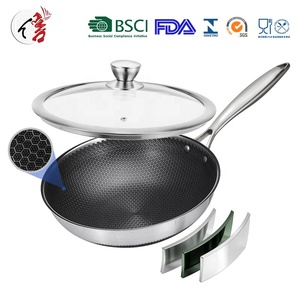
304 Thickened Tri-ply Stainless Steel Honeycomb Wok Non-Stick Household Pan Universal for Induction Cooker & Gas Stove
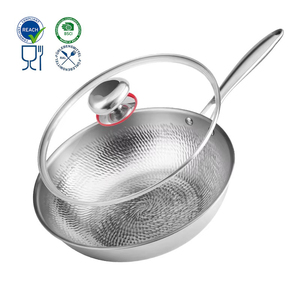
TriPly Stainless Steel Titanium Non Stick Fry Wok Pan Non-stick Induction Hammered Titanium Stainless Steel Wok with Glass Lid
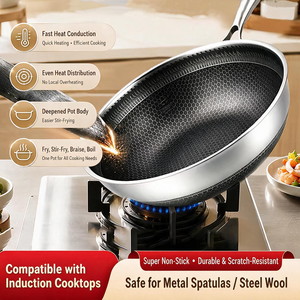
High-quality Non-stick Stainless Steel 304/316 Wok with Glass Cover 18L Capacity Gas & Induction Compatible Cookware Set
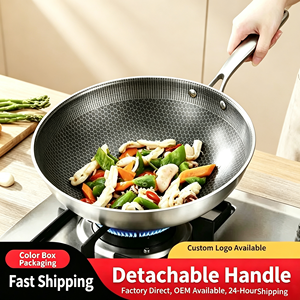
Even Heating Honeycomb Wok Pan 30/32/34cm Riveted Handle Stainless Steel Skillet for Gas Induction Stove
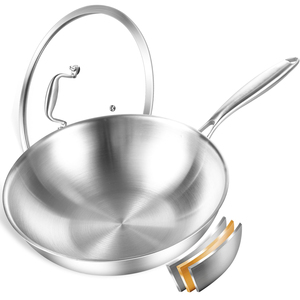
Good Quality Tri-Ply Stainless Steel Wok Durable Cookware Non-Stick Frying Pan for Cooking
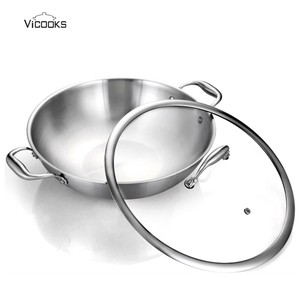
Triply Stainless Steel Woks Stir-Fry Pan with Helpers Induction Wok for Household
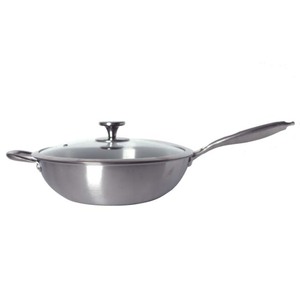
High Quality 304 Stainless Steel Honeycomb Wok Stirfry Pan Tempered Glass Lid Induction Bottom

Premium Thick Bottom 316 Stainless Steel Double Sided Non-Stick Flat Bottom Wok Honeycomb Design with Glass Lid
Material Science Breakdown: 304 vs. 316 Stainless Steel & Tri-Ply Cladding Chemistry
To ensure superior corrosion resistance, structural rigidity under extreme thermal cycling, and optimal induction efficiency, modern cookware engineering leverages specific alloy formulations. B2B buyers must evaluate stainless steel grades based on chemical composition and heat transfer coefficients.
| Property / Alloy Grade | SUS304 (18/8 - 18/10) | SUS316 (18/10/2 Surgical Grade) | SUS430 (18/0 Ferritic Exterior) | Tri-Ply Clad Composite |
|---|---|---|---|---|
| Chromium / Nickel Content | 18% Cr / 8-10% Ni | 18% Cr / 10% Ni / 2% Mo | 16-18% Cr / 0% Ni | Layer Dependent (304/Al/430) |
| Pitting Resistance Equivalent (PREN) | ~ 19.0 | ~ 25.0 (Extreme Acid/Salt Resistance) | ~ 16.5 | Maximized Cooking Surface PREN |
| Thermal Conductivity | 16.3 W/m·K (Low) | 14.6 W/m·K (Low) | 25.5 W/m·K (Moderate) | 205 W/m·K (Al Core Boost) |
| Induction Magnetism | Non-Magnetic (Austenitic) | Non-Magnetic (Austenitic) | Highly Magnetic (Ferritic) | 100% Induction Compatible Base |
| Primary Target Application | Premium Domestic Cookware | Surgical & Heavy Acid/Salt Culinary | Induction Bottom Cladding | Professional & High-End Retail |
Why Tri-Ply Cladding Dominates Modern Procurement
Single-layer stainless steel exhibits poor thermal conductivity (approx. 15 W/m·K), leading to localized hot spots and uneven food scorching. By utilizing continuous high-pressure roll-bonding, our factory fuses an inner layer of Food-Grade SUS304 or SUS316 with an ultra-conductive Pure Aluminum Core (Al 1050) and an outer magnetic SUS430 Stainless Steel shell.
This tri-ply matrix eliminates hot spots by spreading thermal energy laterally across the pan walls, reducing energy consumption by up to 35% on commercial induction burners while maintaining structural anti-warping stability up to 450°C.
Future Procurement Trends in Wholesale Stainless Steel Cookware
Key technology, regulatory, and material shifts transforming international cookware import strategies over the next decade.
1. Laser Honeycomb Micro-Structure Etching
Traditional PTFE non-stick coatings suffer from thermal degradation and scratching. The industry is rapidly transitioning to laser-engraved honeycomb physical matrices where stainless steel ridges protect the recessed non-stick cells, extending cookware lifespan by 5x in commercial usage.
2. PFOA & PFAS-Free Green Compliance
With the European Union tightening REACH regulations and North America expanding PFAS restriction legislation, importers must verify zero-chemical non-stick technologies. Plasma-sprayed titanium matrixes and pure ceramic-reinforced coatings are now mandatory for high-tier brand positioning.
3. High-Frequency Seamless Induction Bonding
Legacy impact-bonded capsulated bases risk separation after repeated thermal shocks. Future procurement mandates full-body clad tri-ply construction or high-frequency automated magnetic seam welding to ensure zero energy efficiency loss over 10+ years of heavy service.
Industry Development Trends in Cookware Manufacturing
To remain competitive, leading China cookware exporters are investing in advanced robotics, smart hydraulic press lines, and eco-friendly surface passivation techniques.
Automated Cold-Pressing & Deep-Drawing
Multi-stage hydraulic deep-drawing presses ensure precise wall thickness distribution (+/- 0.02mm tolerance). This prevents metal thinning at bottom radii corners, eliminating structural structural failures under intense thermal loads.
Rivetless Laser Welding Technology
Traditional riveted handles trap food residues and bacteria inside the pan interior. Automated capacitor-discharge laser spot welding creates seamless inner pan surfaces while exceeding 2,500 N handle shear tension requirements.
Eco-Friendly Passivation Surface Finishing
Replacing harsh nitric acid pickle solutions with citric-acid ultrasonic passivation builds a thick, uniform chromium oxide layer. This increases salt spray test resistance to > 72 hours under standard ASTM B117 protocol.
Smart Modular Tooling for Rapid OEM
Standardized die inserts reduce private-label custom mold development lead times from 60 days down to 15 days, allowing global brands to rapidly introduce custom handle shapes, bottom logos, and unique capacity dimensions.
Frequently Asked Questions for Global Cookware Importers
Technical, operational, and commercial answers to simplify your global B2B OEM sourcing process.
Why Partner with Our Wholesale Stainless Steel Cookware Manufacturing Facility
With over 15 years of focused engineering expertise, our fully integrated production facility controls every step of cookware manufacturing — from raw steel coil inspection to final automated polishing and packing.
Vertically Integrated Production
In-house stamping, hydraulic cladding, laser etching, handle riveting, mirror polishing, and automated packaging lines ensure total quality oversight and cost optimization.
10,000+ Existing Product SKUs
Access an extensive catalog of proven cookware designs, woks, stock pots, pressure cookers, steamers, and kitchenware accessories ready for rapid private-label deployment.
End-to-End Export Logistics
Dedicated international trade service team handling FOB, CIF, DDP shipping, customs clearance documentation, third-party lab inspection (SGS/TUV), and container packing optimization.