Navigating Commercial Stainless Steel Cookware Manufacturing in China
The commercial food service industry demands cookware engineered for relentless high-thermal throughput, rigorous chemical sanitation, and extreme structural durability. As global hotel groups, restaurant chains, and commercial kitchen equipment distributors evaluate supply partners, China remains the global nexus for advanced stainless steel metallurgy and automated deep-drawing manufacturing. This technical report details metallurgical standards, OEM production capabilities, and key product specs for high-volume procurement managers.
Top-Rated Commercial Stainless Steel Cookware & Woks
Precision-engineered 304 & 316 tri-ply cladded cookware optimized for commercial gas ranges and rapid-induction cooktops.
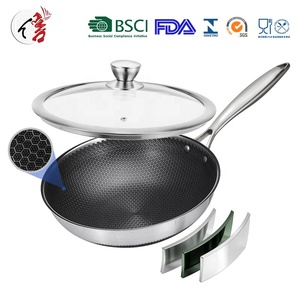
304 Thickened Tri-ply Stainless Steel Honeycomb Wok Non-Stick Pan
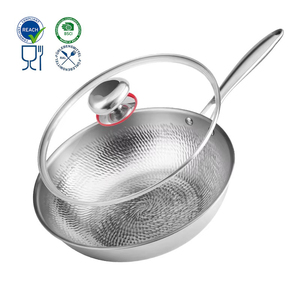
TriPly Stainless Steel Titanium Non-Stick Hammered Wok with Glass Lid
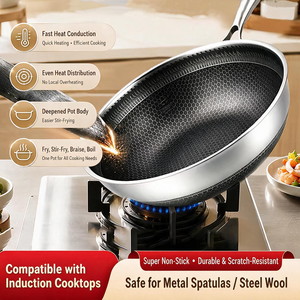
High-Quality Non-Stick Stainless Steel 304/316 Wok 18L Capacity Set
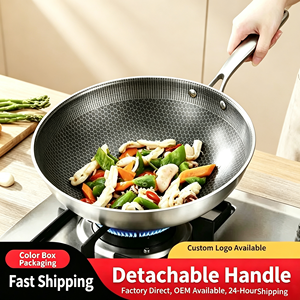
Even Heating Honeycomb Wok Pan (30/32/34cm) with Cast Steel Handle
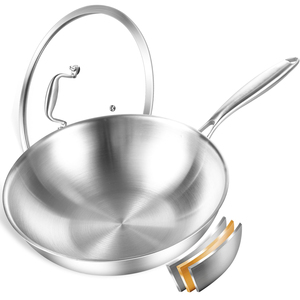
Good Quality Tri-Ply Stainless Steel Wok Durable Non-Stick Skillet
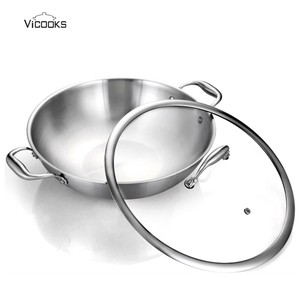
Tri-Ply Stainless Steel Stir-Fry Wok with Ergonomic Helper Handles
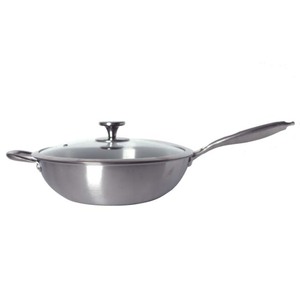
304 Stainless Steel Honeycomb Stir-Fry Pan with Tempered Glass Cover

Premium Thick Bottom 316 Stainless Steel Double-Sided Honeycomb Wok
OEM & ODM Manufacturing Infrastructure Capabilities
Why tier-1 global importers, hotel supply brands, and restaurant equipment distributors contract leading Chinese stainless steel factories.
Metallurgical Purity & Compliance
Utilizing direct-mill certified 18/10 (SUS304) and 18/12 (SUS316) stainless steel coils. Standardized X-ray fluorescence spectroscopy verifies zero toxic heavy metal leaching, ensuring absolute compliance with FDA 21 CFR, LFGB, and EU Regulation (EC) No 1935/2004.
Heavy Pressing & Cladding Lines
Equipped with 2,500-ton hydraulic friction welding and deep-drawing presses. Factory lines integrate multi-ply cladding (3-Ply, 5-Ply, 7-Ply) linking magnetic 430 stainless steel bases with high-purity aluminum cores for zero-hotspot heat distribution.
Laser Micro-Etching Technology
Advanced German fiber-laser engraving systems create precise honeycomb physical elevation grids. This protective ridge matrix shields the PFOA-free non-stick layer from heavy commercial metal spatulas, extending wok service lifespans by over 400%.
Commercial Stainless Steel Cookware Grade Matrix
Procurement managers must select the proper alloy composition based on thermal intensity, salt exposure, and dishwashing cycles.
| Material Standard | Alloy Composition | Corrosion Resistance | Thermal Conductivity | Best Commercial Application |
|---|---|---|---|---|
| SUS304 (18/8 - 18/10) | 18% Cr / 8-10% Ni | High (Standard Acids) | Medium (Requires Alu-Core) | General Restaurant Pans, Stock Pots, Buffet Steamers |
| SUS316 (18/12 Mo) | 18% Cr / 10-12% Ni / 2-3% Mo | Extreme (High Salt/Acid) | Medium (Requires Alu-Core) | Seafood Boiling Pots, High-Acid Sauce Pans, Heavy Woks |
| Tri-Ply Cladded | 304 Interior + Alu + 430 Base | High Interior / Magnetic Base | Exceptional (Uniform Wall Heat) | High-Speed Commercial Induction Stir-Fry & Saute |
| Encapsulated Bottom | Single-Wall 304 + Impact Base | High Interior Body | Bottom-Concentrated | Economy Hotel Cookware, High-Capacity Soup Kettles |
Technological Innovations Shaping Restaurant Cookware Manufacturing
Commercial kitchen procurement is undergoing a paradigm shift driven by rising energy tariffs, stringent safety regulations, and fast-paced kitchen operations. Leading Chinese OEM factories are investing heavily in automated production and material engineering to address these macro challenges.
1. Next-Gen 5-Ply & 7-Ply Thermal Cladding
Traditional single-ply cookware suffers from severe hot-spotting under high-BTU commercial gas jets, leading to burnt food and structural warping. Modern factories utilize continuous roll-bonding to join up to seven layers of metal (including pure copper cores, structural aluminum alloys, and ferritic stainless steel). This multi-ply architecture delivers near-instantaneous thermal lateral distribution, reducing restaurant gas and electricity consumption by up to 28%.
2. Physical Non-Stick Micro-Laser Hexagon Structures
Commercial kitchens historically avoided non-stick pans due to rapid coating degradation caused by stainless steel tools and high heat. The integration of dual-sided honeycomb laser etching resolves this dilemma. Raised stainless steel peaks take the brunt of utensil mechanical friction, while recessed valley zones hold food-grade, PFOA-free coatings, offering chef-grade non-stick performance with industrial durability.
Key Takeaway for B2B Buyers: Investing in Tri-Ply and Honeycomb-etched cookware reduces restaurant kitchen replacement cycles from 6 months to over 36 months, delivering a significantly lower Total Cost of Ownership (TCO).
Strategic Procurement Trends in Commercial Cookware (2025–2030)
Custom Branding & OEM Tooling
Global distributors are moving away from unbranded generic stock. Contract manufacturing now routinely includes custom laser logo engraving, specialized casting for ergonomic chef handles, bespoke bottom stamping, and customized retail color packaging.
Shift to Full Induction Optimization
With modern commercial kitchens transitioning to flameless induction cooktops for temperature precision and lower HVAC cooling costs, procurement strategies prioritize cookware featuring 430 ferritic magnetic bottoms or bonded impact bases.
Eco-Friendly & Plastic-Free Supply Chains
Strict European ESG mandates require manufacturers to eliminate PFOA/PFAS chemical non-stick coatings and transition to recyclable kraft master carton packaging, zero-plastic interior wrapping, and low-carbon footprint stainless steel sourcing.
Frequently Asked Questions (FAQ) for Commercial Buyers
Critical answers regarding minimum order quantities, factory auditing, quality assurance testing, and international shipping logistics.
Q1 What is the standard Minimum Order Quantity (MOQ) for custom OEM stainless steel cookware?
For standard stock catalog cookware, factory MOQs typically range from 200 to 500 units per SKU. However, for fully customized OEM orders—such as custom handle casting, branded bottom stamping, or bespoke color box packaging—the standard production batch MOQ is generally 1,000 to 2,000 units. Aggregated multi-SKU container orders (20ft/40HQ) often qualify for flexible split MOQs.
Q2 How do SUS304 and SUS316 stainless steel cookware differ in commercial restaurant use?
SUS304 (18/10 stainless steel) is the industry standard for general commercial cooking, providing excellent corrosion resistance and mechanical strength. SUS316 contains 2–3% molybdenum, which dramatically increases resistance to pitting caused by sodium chloride (table salt), acidic food sauces, and harsh dishwashing chemicals. SUS316 is heavily favored by premium hotel chains and specialized seafood restaurants.
Q3 What quality control (QC) testing protocols should be demanded before shipping?
Professional B2B buyers mandate four critical factory QA tests: (1) Spectrometric Material Analysis to verify alloy percentage compliance; (2) Neutral Salt Spray Testing (NSS) for 72-96 hours to guarantee rust resistance; (3) Thermal Shock Drop Testing heating cookware to 250°C and quenching in cold water to check for bottom warping; and (4) Rivet/Handle Tensile Strength Tests applying static loads up to 100 kg.
Q4 How does Tri-Ply cladded stainless steel prevent cookware thermal warping?
Tri-Ply construction permanently bonds a core layer of high-purity aluminum between two sheets of stainless steel using heavy roll-bonding pressure. Because aluminum expands and conducts heat five times faster than steel, it distributes heat uniformly across the entire vessel base and sidewalls, preventing structural localized hotspots that cause bottom bulging and warping.
Q5 What international food contact safety certifications are provided by top Chinese factories?
Leading export manufacturers supply certified testing reports from independent inspection bodies (such as SGS, TÜV, or Intertek). These include FDA 21 CFR 175.300 for US markets, European Regulation (EC) No 1935/2004, German LFGB approval, and ISO 9001:2015 quality management system compliance.
Q6 Can factories manufacture cookware compatible with high-power commercial induction ranges?
Yes. Induction compatibility requires a magnetic layer at the base. Top factories manufacture Tri-Ply cookware with an outer layer of magnetic AISI 430 (18/0) ferritic stainless steel, or impact-weld a 430 magnetic capsule disc onto 304 stock pots, enabling rapid magnetic induction heating up to 350°C.
Q7 What lead times are typical for bulk production and container shipment?
Standard repeat orders for catalog cookware require approximately 25 to 35 days for production. New OEM projects requiring custom mold development, handle tooling, and sample approval add 15 to 25 days to the initial schedule. Sea freight transit times range from 14 to 35 days depending on the destination port.
Request Your Commercial Wholesale Catalog & Pricing
Access direct factory FOB pricing, detailed technical specifications, OEM custom mold options, and sample dispatch request forms for bulk commercial orders.